From 200 CVs to 12 Top Candidates: How AI Resume Parsing Saves SMBs Hours
Hiring managers at small and mid-sized businesses often face the same struggle: a single job post can attract hundreds of applications, and sorting through them takes days. Valuable hours are lost scanning resumes line by line, leaving teams overwhelmed and at risk of overlooking strong candidates. This is where technology steps in.
AI resume parsing helps streamline the process by quickly analyzing resumes, identifying key qualifications, and producing a focused shortlist. In this article, you’ll find ai resume parsing explained in plain language, along with practical insights into how it saves SMBs time, improves accuracy, and helps them hire more effectively.
What Is AI Resume Parsing?
Resume parsing is the process of automatically extracting information from resumes and organizing it into a structured format. Instead of a recruiter manually reading each document, software identifies details like skills, work history, and education, then places them into a database for easier review.
Traditional systems rely mostly on keyword matching. If a job description asks for “sales management,” these tools simply search for that exact phrase. The problem is that they often miss candidates who list related terms, such as “business development” or “account management.”
AI resume parsing takes the process further. Using Natural Language Processing (NLP) and machine learning, it understands context and synonyms. This means it can recognize that “CPA” is linked to accounting or that “Java” is a programming language, not just a random word. By doing this, AI delivers more accurate shortlists.

How AI Resume Parsing Works Step by Step
AI resume parsing might sound complex, but the process is straightforward when broken down into simple steps. By understanding each stage, SMBs can see exactly how the technology transforms a large pile of resumes into a clear, actionable shortlist.

Data Extraction
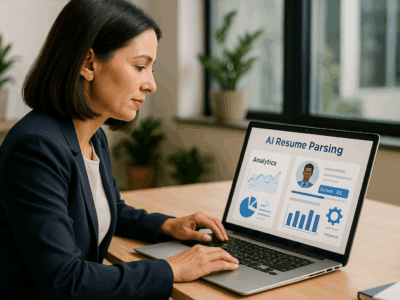
The first step is scanning resumes in different formats such as PDF, Word, or even text copied from email. The AI pulls out key details like work experience, education, skills, and certifications, then organizes them into a structured format. This saves recruiters from copying information manually into spreadsheets.
Contextual Understanding
Once the data is collected, the AI interprets it. Unlike older tools that only match exact words, AI can recognize related terms and context. For example, it knows that “front-end developer” and “React engineer” may describe similar skill sets, or that “CPA” is tied to accounting expertise. This allows the system to pick up qualified candidates even if they use different wording.
Scoring and Ranking
Next, the AI compares resumes against the job description. It assigns a score to each candidate based on relevance, highlighting those who are most closely aligned with the role’s requirements. This ranking helps recruiters focus on the strongest applicants first, making their review process more strategic and efficient.
Human Review and Calibration
Recruiters review the high-scoring candidates and confirm that the criteria fit the role. They can adjust scoring weights, add must-have skills, and save these settings for similar openings. This step keeps the results aligned with real hiring needs.
Shortlist Generation
Finally, the system produces a focused shortlist. Instead of facing 200 resumes, the recruiter sees perhaps 12 top candidates who best match the position. This makes the review process faster, more accurate, and far less overwhelming.

Key Features to Look For in an AI Resume Parsing Tool
When choosing an AI resume parsing solution, small and mid-sized businesses should focus on features that directly improve hiring speed and accuracy. Here are the essentials:
Accuracy Across Formats
The tool should be able to handle resumes in different formats, including PDF, Word, and text. Accurate extraction ensures no important details are lost, regardless of how the candidate submits their application. A reliable system also minimizes errors like misreading dates or mixing up job titles.
Customizable Scoring
Every role is different. A good parser allows recruiters to adjust scoring criteria so candidates are ranked based on the skills and qualifications that matter most for the position. This flexibility ensures the shortlist reflects the unique needs of each department or project.
Built-In Analytics
Reports and metrics give hiring teams clear insights into the process. With built-in analytics, recruiters can see how long each stage takes, where candidates drop off, and how hiring performance improves over time. These insights help managers make smarter decisions and present results to leadership.
Easy Integration
The parser should work smoothly with other tools, such as job boards, applicant tracking systems, and calendars. This reduces manual effort and keeps the entire hiring process connected. Seamless integration also allows teams to keep using the platforms they already know.
Cost-Friendly for SMBs
Affordability is key. The best solutions provide strong functionality at a price that makes sense for smaller teams without large HR budgets. Transparent pricing helps SMBs adopt the tool confidently without unexpected costs later.
Future of AI in SMB Hiring
AI resume parsing is only the beginning. Future tools are expected to support multiple languages, making it easier for businesses to hire across borders. Advances in context analysis will allow the software to better understand industry-specific terms and evolving job roles.
Many systems are also being designed to reduce unconscious bias, helping teams make fairer hiring decisions. For small and mid-sized businesses, adopting these innovations early means staying competitive in tight labor markets where speed and accuracy make a difference.
Final Words
For small and mid-sized businesses, hours spent sorting through hundreds of resumes can slow down hiring and cause great candidates to slip through the cracks. AI resume parsing changes that by turning 200 CVs into a shortlist of the top 12 in minutes. It saves time, improves accuracy, and gives teams the confidence to make better hiring decisions. The future of SMB recruiting lies in tools that simplify complex tasks.
By adopting AI-driven solutions, smaller teams can compete with larger organizations that have dedicated recruiting departments. What once felt out of reach; fast, fair, and data-backed hiring, is now practical and affordable for SMBs.
Start your journey with Sourcio.ai. Discover how our AI-powered resume parsing helps SMBs hire smarter, faster, and more efficiently.